

-
Yes, our clothing brand is designed by Mi’kmaw and Indigenous artists but is for everyone to proudly wear. This is a form of cultural appreciation; by wearing our clothing you are showing your solidarity with our communities and supporting the Mi’kmaw Native Friendship Centre!
-
The confusion between cultural appreciation and appropriation is a valid concern if you’ve never been taught to understand the difference. Traditional regalia is something we do not sell to the public; often these pieces are handcrafted and gifted or can be passed down generationally. Regalia is typically worn for special ceremonies and during a mawiomi (powwow) because it is the extension of one's spirit. Every piece of someone's regalia is unique and tells a part of the dancer's story, this part of Indigenous culture is incredibly sacred to our communities which is why it is often not shared with the public. We have seen regalia mocked within the media far too many times; sports mascots, Halloween costumes and countless viral videos. When people mock or imitate a different culture for financial profit or social gain, that is cultural appropriation.
Cultural appreciation looks much different. Respectfully attending community events (such as a powwow) and supporting Indigenous artisans & vendors is a form of appreciation. Purchasing handcrafted jewelry by Indigenous artists and proudly sharing about the artist when people inevitably ask where it's from, is cultural appreciation. Having meaningful conversations and making space for Indigenous people in your workplace/school/community is a form of appreciation. We are all learning, if you are unsure if something will be considered on one side or the other – the best thing to do is simply to ask and listen.
-
For decades the Halifax waterfront has been known for hosting annual events and festivals to establish a sense of community in our small but growing city. This same waterfront has been known by the Mi’kmaw as Kjipuktuk translated to ‘Great Harbor’. Since time immemorial Kjipuktuk had been a central hub for trade, transportation and most importantly, community.
Our goal is to reinstate the Mi’kmaw presence on our ancestral lands by showcasing the resilience our people carry through their artwork. Throughout history, legislation has been invoked countless times upon Indigenous communities to suppress their stories and culture. Just a few examples from the Indian act include prohibiting our ancestors from speaking in their native tongue, from engaging in ceremonies, from wearing regalia and even from dancing. Although significant damage has been done, Indigenous people across Turtle Island are proudly reclaiming their languages, indulging in ceremonies, creating & proudly wearing their regalia.
-
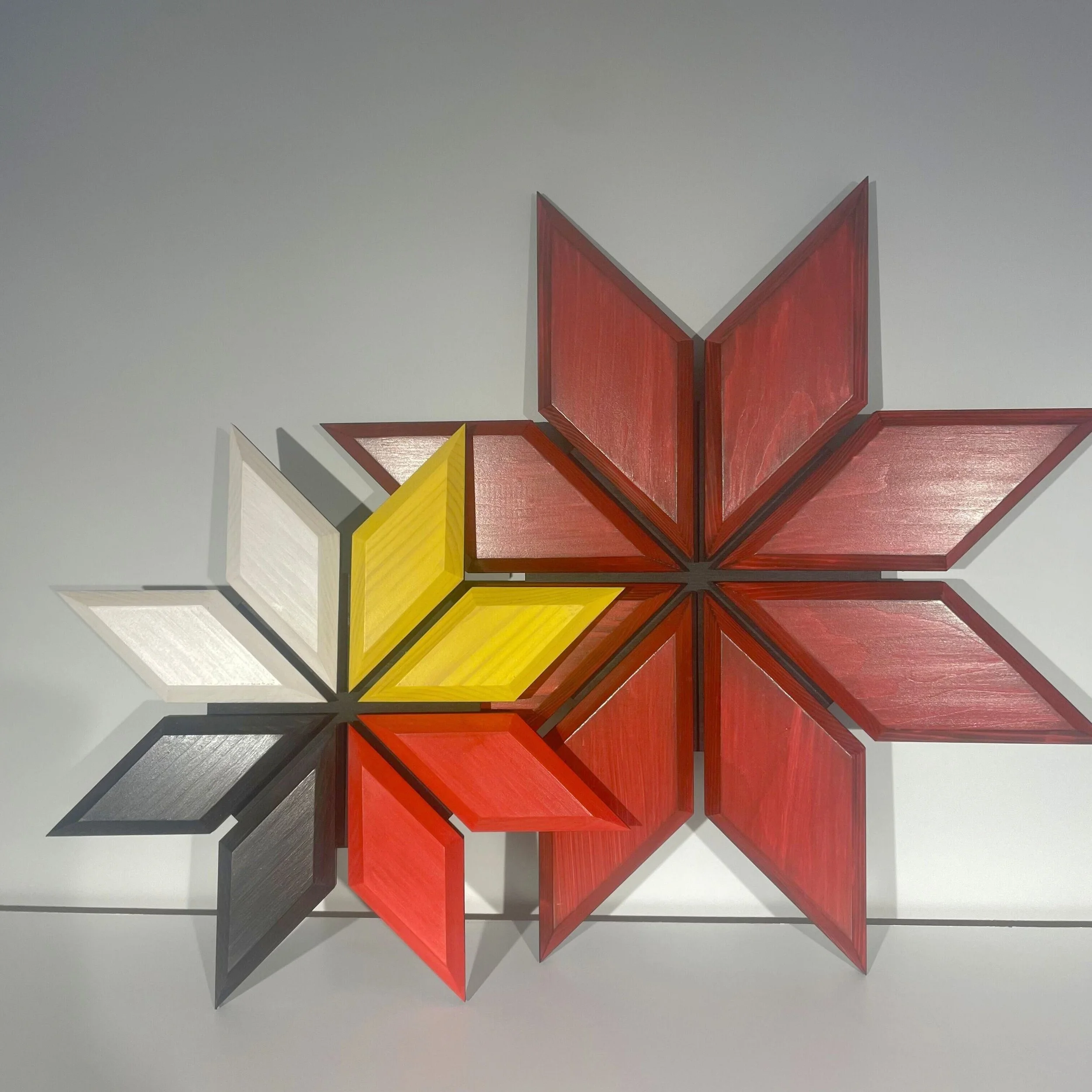
Our signature motif is a design rooted in Mi’kmaw history. It features the double curve design which has been used in Mi’kmaw beadwork & designs since time immemorial. There is no singular definition of the meaning of this symbol because of the damage colonialism has taken on Indigenous oral traditions. Many view the two curves as the connection between themselves and the land, some view it as a traditional kwitn (canoe) and some chose to keep the meaning sacred within their communities. The K design is intentional, it is for Kjipuktuk which translates to the Great Harbour in the Mi’kmaw language. In 1749, the city of Halifax was founded within our territory; which violated the peace and friendship treaties and further expelled our ancestors from their traditional lands. Our design intends to spread the message that we are still here, a message that tends to get lost within the greater narrative of colonialism in the 21st century.
Frequently Asked Questions
Language Frequently Asked Questions
Long before European contact, thousands of unique Indigenous languages were spoken across Turtle Island. The European colonization of the Americas deliberately assimilated and erased entire populations of Indigenous people. Our languages were interwoven with the land and ways of life of our ancestors. The words carry the teachings of those who have come before us; by decolonizing the everyday English terms we use, the Mi’kmaw world view becomes much easier to understand. Colonial systems would strategically sever the connection between language and culture by forcibly assimilating Indigenous children through residential and Indian day schools. Indigenous students were not permitted to speak in their native tongue while attending these schools, disobedience frequently resulted in punishments and harsh consequences. Without constantly communicating in their native languages, children lost the ability to speak to their families. Some children were shunned by their communities because of the erasure of culture. Indigenous youth were fed a narrative to disconnect them from their families; in many cases this was passed on when they had their own children. This is not necessarily because they believed this prejudice; some parents feared what might happen to their own children if they were perceived as natives. These schools had high rates of abuse which manifests into the generational trauma that descendants are navigating today. This would be the leading factor in the extinction and endangerment Indigenous languages.
This is not an isolated issue; language revitalization programs are growing in numbers across the world because of the high risk of endangerment and extinction. The United Nations estimates that every month, two Indigenous languages become extinct (UN News). The research conducted between Statistics Canada and the Office of the Commissioner of Indigenous Languages found that as of 2025 there are 9245 Mi’kmaq speakers with 62.8% having Mi’kmaq as their mother tongue. Our language is endangered; at Sitamuk Cultural Post we encourage everyone to ask questions and learn some Mi’kmaq words while in the shop.
Mi’kmaq to English Translations:
Sitamuk (Seet-ah-mook) By the water
Mi’kma’ki (Mee-gim-aaah-gee) Mi’kmaw Territory
Kjipuktuk (Ook-Jee-Book-dook) The Great Harbour (Halifax)
Tapsun (Dab-soon) Clothing
Pjilasi (Ep-jih-lah-see) Welcome
We have developed a line of products that focuses on sharing our language, one example of this is our toddler feeding set. Learning multiple languages is easier for young children which is why this product is an easy way for parents and caretakers to incorporate Mi’kmaq at a critical age.
Toddler Feeding Set translations:
Samqwa (Sum-gwah) Drink
Mijisi (Mee-jee-see) Eat
Lasiet (Lah-see-ett) Plate
Sapte’kney (sap-day-guh-nay) Fork
Emqwanji’j (Em-hgwan-jeech) Spoon
Online Language Resources:
Free online dictionary with audio and phonetics. Each definition has three different Mi’kmaw speakers recorded. These are primarily Listiguj speakers.
Mi'gmaq/Mi'kmaq Online Talking Dictionary
L’nui’suti
Free app intended for non-speakers to learn the Mi’kmaw language developed by Mi’kmaw Kinamatnewey. Content in this app is in the first-person singular and spoken in the Unama’ki/Cape Breton dialect.
Available on the app store and google play
Tal-Tluen
Free Mi’kmaw phrase building app developed by Mi’kmaw Kinamatnewey
Available on the app store and google play
Mi’kmaw Conversation
Free conversational Mi’kmaw app featuring a speaker from Maupeltu (Membertou) First Nation
Developed by Marie-Odile Junker
Copyright by Algonquian Linguistics Atlas
References:
Two indigenous languages are dying every month: UN Assembly President | United Nations